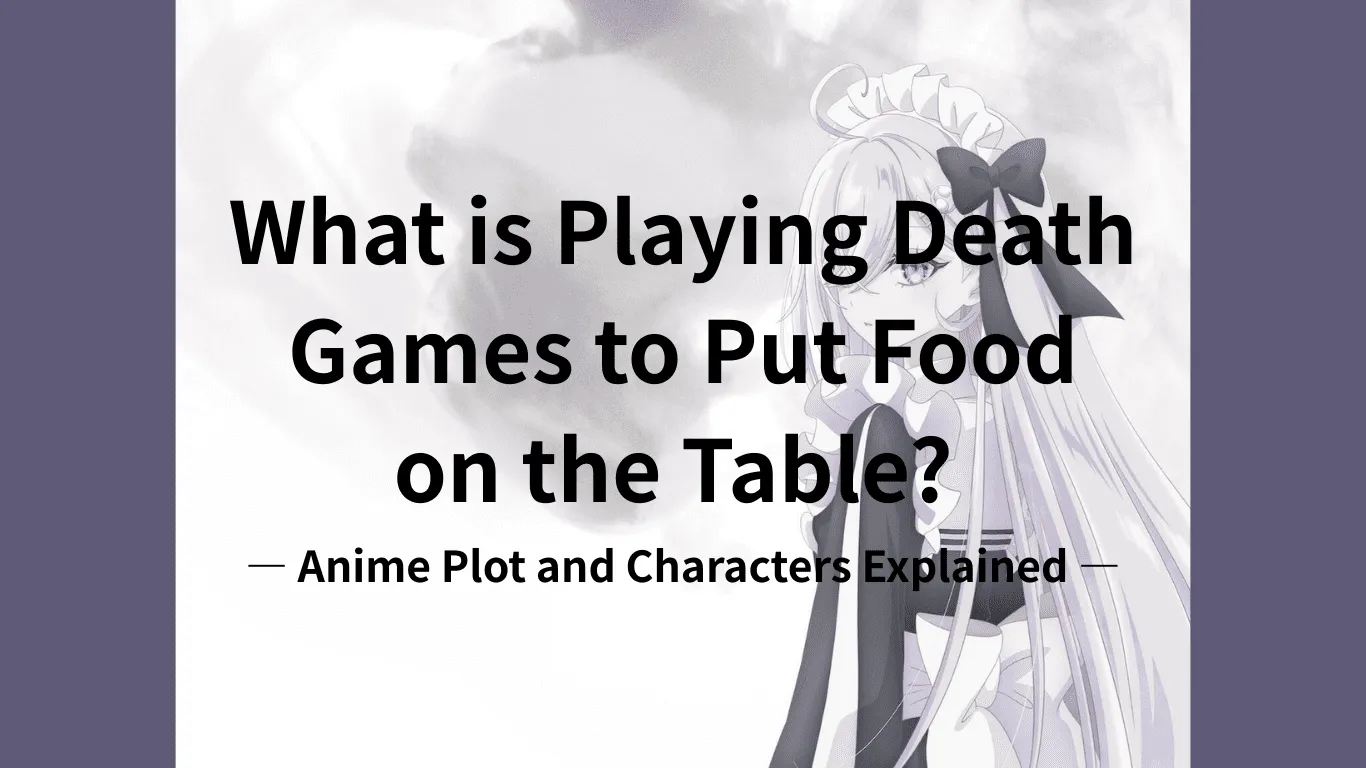
The “Death Game” genre has long been a staple of Japanese media, from the cult classic Battle Royale to the psychological mind games of Liar Game and the global phenomenon Alice in Borderland. However, a new contender has emerged that flips the entire premise on its head.
Playing Death Games to Put Food on the Table (Japanese: Death Game de Meshi wo Kuu) isn’t just about surviving—it’s about the grind. It treats lethal survival games not as a tragic once-in-a-lifetime event, but as a career choice. This guide will dive deep into the characters, the lore, and the unique mechanics that make this series a must-read for any subculture enthusiast.
- What is “Playing Death Games to Put Food on the Table”?
- The Gritty Reality: Why This Series Reinvents the Death Game Genre
- Meet the Professional Players: Character Profiles
- Understanding the Rules and the World
- Deep Dive into Themes: The Desensitization of Violence
- A Beginner’s Guide: How to Start Reading/Watching
- Frequently Asked Questions (FAQ)
- Conclusion
What is “Playing Death Games to Put Food on the Table”?
The Origin and Premise
Originally a light novel series written by Yūki Ukai and illustrated by Nekometal, Playing Death Games to Put Food on the Table won the prestigious 34th Fantasia Taisho Grand Prize. In a market saturated with “Isekai” and “Villainess” stories, this series stood out by grounding the high-concept death game trope in the mundane reality of poverty and labor.
The story follows a young girl named Yuuki (also known by her player handle). In this world, mysterious “Death Games” are held regularly, and participants—usually those in desperate financial straits—are recruited to play. If you win, you get a massive payout. If you lose, you die.
A Professional Perspective
Unlike other series where characters are forced into games against their will, the protagonist here is a professional player. She has survived multiple games and views each lethal encounter with the same weary pragmatism most people feel toward a 9-to-5 job. It’s this “blue-collar” approach to extreme violence that gives the series its dark, satirical edge.
- Source Material: Light Novel (MF Bunko J / Kadokawa)
- Manga Adaptation: Monthly Comic Alive
- Official Link: MF Bunko J Official Site
The Gritty Reality: Why This Series Reinvents the Death Game Genre
What makes this series truly special is its subversion of expectations. Here is why it feels so fresh:
The “99% Survival” Logic
In most death games, the fatality rate is 99%. In Death Game de Meshi wo Kuu, it’s the opposite. The games are designed so that experienced players have a high chance of survival. However, that remaining 1% chance of death is ever-present. This creates a unique tension: characters aren’t screaming in terror; they are calculating risks.
The Mundanity of Horror
After the games, Yuuki goes back to her cheap apartment, eats convenience store food, and worries about her bills. The juxtaposition of escaping a giant killer robot or a poisoned labyrinth one day and doing laundry the next is both jarring and fascinating. It portrays the death games as a metaphor for “black companies” (exploitative workplaces) in Japan, where employees risk their health for a paycheck.
Psychological Detachment
The series explores how a person becomes desensitized to trauma. Yuuki’s internal monologue is often cold and analytical. Seeing her interact with “newbies” who are terrified provides a stark contrast that highlights her growth—or perhaps her descent into numbness.
Meet the Professional Players: Character Profiles
Yuuki (The Protagonist)
Yuuki is the heart of the series. She is a high school-aged girl who has chosen the life of a professional player. She isn’t a “chosen one” with superpowers; she is simply observant, cautious, and incredibly lucky.
- Motivation: Survival and financial stability. She doesn’t want to save the world; she wants to pay her rent and eat well.
- Personality: Stoic, pragmatic, and occasionally witty. She avoids making deep emotional connections with other players because she knows they might be dead by tomorrow.
The “Disposable” Cast and Recurring Rivals
Because this is a death game series, the cast is revolving. However, the story introduces other “Pros” who share Yuuki’s mindset. These interactions reveal the different archetypes of survivors:
- The Strategist: Those who treat the game like a math puzzle.
- The Berserker: Those who rely on raw physical instinct.
- The Traitor: Those who realize that killing others is the easiest way to ensure their own victory.
Understanding the Rules and the World
The Mechanics of the Game
The games vary wildly. Some are physical challenges, others are psychological puzzles. However, they all share common traits:
- Clear Win Conditions: There is always a way to win without everyone dying.
- Monetization: The games are clearly being funded by some unseen “audience” or organization, though their identity remains a mystery.
- The Payout: Winners receive a “Life Point” or currency that can be exchanged for huge sums of money.
The Mystery of the Organizers
Who is running these games? Unlike Danganronpa with its Monokuma or Saw with Jigsaw, the organizers here are mostly faceless. This adds to the feeling of the games being a “system” rather than a personal vendetta. It’s a corporate-style horror where the individual is just a cog in the machine.
Deep Dive into Themes: The Desensitization of Violence
The core theme of the series is normalization. How much can a human being endure before “extraordinary horror” becomes “ordinary work”?
- Labor Exploitation: The series acts as a critique of modern capitalism. Yuuki is essentially a freelance contractor in the most dangerous gig economy imaginable.
- Isolation: The life of a pro player is lonely. You cannot tell your “normal” friends what you do, and your “work” friends are constantly dying.
- The Value of Life: The title itself—to Put Food on the Table—suggests that life is cheap, but the will to live is driven by the most basic human needs.
A Beginner’s Guide: How to Start Reading/Watching
If you are new to the series, here is how you can jump in:
- The Light Novel: This is the original source and contains the most internal monologue and world-building details. (Japanese: Death Game de Meshi wo Kuu)
- The Manga: If you prefer visuals, the manga adaptation by Ziko does a fantastic job of capturing the tension and Yuuki’s “dead-eyed” expressions.
- Anime News: As of early 2026, fans are keeping a close watch on production studio leaks. Given its status as a Fantasia Taisho winner, an anime adaptation is highly anticipated by the global community.
Official Publisher (Japan): Kadokawa / MF Bunko J
Frequently Asked Questions (FAQ)
A: While there is violence, the focus is more on psychological tension and strategy. It is “Seinen,” so expect some blood, but it isn’t pure “torture porn.”
A: While both involve playing games for money, Squid Game is a one-time event for the characters. In this series, the characters go back to the games voluntarily as a “job.”
A: Romance is not the primary focus. The story centers on Yuuki’s survival. Any relationships formed are usually colored by the suspicion inherent in the games.
Conclusion
Playing Death Games to Put Food on the Table is a brilliant subversion of a tired genre. By stripping away the melodrama and replacing it with the cold, hard reality of “making a living,” it creates a story that feels uncomfortably relatable. Whether you are a fan of high-stakes thrillers or a reader looking for a deep dive into the psychology of labor and survival, this is a series you cannot afford to miss.
Will Yuuki ever be able to “retire,” or is the cycle of death the only thing she has left? The journey is as harrowing as it is addictive.